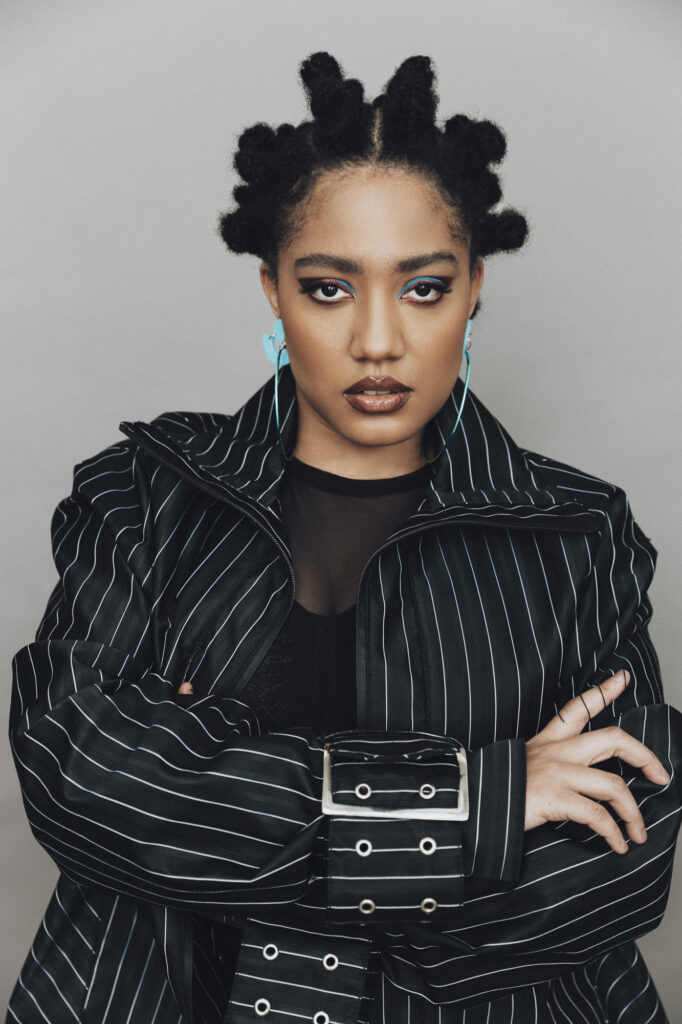
Juneteenth has passed, but our celebration of Black culture doesn’t end there.
June also marks Black Music Month, first recognized [what does that mean?] under President Carter in 1979 to commemorate the multitude of ways Black music has shaped American life—its influence on popular genres like rock and roll and pop, its innovation and expression through hip hop culture, and its raw, radical messaging in the hands of truth-tellers like Billie Holiday.
And who better to help The Fine Print explore the depth and power of Black music than Boston-born Black artists Zakiyyah Sutton and James Fortes—aka DJ Mez.Wav—two of Embrace’s current Artists-in-Residence who live, breathe, create, and curate Black music every day?
Here are our conversations with Zakiyyah and Mez, lightly edited for clarity.
On how they became drawn to making music
Zakiyyah: A few people come to mind immediately. Looking to the past, I’m thinking of Lauryn Hill. What I admire about her is that she makes music that’s conscious but still fun—you still want to dance to it. That’s something I strive for too, because sometimes people don’t want to hear the conscious stuff, but you can still draw them in if it has a good beat. I also think about Leontyne Price, who is like my vocal mama, and my brother Rip Shop, a Boston rap legend who taught me a lot about rap indirectly just by being in his presence. From a current standpoint, the first person who comes to mind is Sampa the Great. She is someone I would love to collaborate with one day—if you see this, holla at your girl! The first time I heard her music, I was like, it’s just so unapologetically pro-Black and so raw. The power she holds in her artistry really resonates with me. I can see myself in her, and I find that very inspiring.
For me, it’s a matter of being authentic to what I’m feeling. The Black experience is complex, so just by engaging with my art in a way that allows me to express various facets of myself, I’m by extension also expressing various facets of Black identity.
Mez: To be honest, [my love of making music] started in college. I used to run a music blog, kind of similar to 2DopeBoyz, NahRight, or Pigeons & Planes—just highlighting new music, putting people on. But actually, it started even earlier than that. In middle school, I used to make mixtapes for my classmates and sell them. That urge to find new music and always be up on what was fresh just followed me into college. I’d throw dorm parties, playing music through a program called Virtual DJ—not really DJing yet, just making playlists and having people come vibe in my room.
Then at a family party, the DJ—a close family friend—needed to step away and told me just to press a button and hold it down while he was gone. When he came back, I was already mixing on beat. He asked how I knew how to do that, and I told him I’d messed around with some apps. That was the moment the bug really hit me. I asked him how I could get set up, and he said he’d sell me everything. This was back in 2018. The next day I went to his house, bought all the equipment, and it started from there. I took every opportunity I could—birthday parties, baby showers, cookouts, community events—and it just grew from there. What’s really helped me is having a deep love for music, and finding the people who had that same appreciation. It’s been a blessing.
On what the celebration of Black Music Month means to them
Z: I think it’s important that we acknowledge that so many of the contemporary music art forms we enjoy today were inspired by Black music and Black culture—it is the origin of so much of what we do. Connecting back to Black history overall, Black music has played such a pivotal role in disrupting harmful systems, empowering Black voices, and speaking truth to power in ways that other traditional mediums couldn’t.
Mez: For me, Black music means so much. So much of the music in the world comes from Black music. You think about rock and roll, hip-hop, R&B, house music, blues. Even down to the instruments — the banjo, for example, stems from Africa. Black culture has its finger on the pulse of all kinds of music genres. And even now, when I play events, the music that really resonates with people is the stuff that’s been sampled from earlier eras. You’ll hear a song going crazy right now that’s sampling something from the 2010s, and that song was actually sampled from something from the ’70s, which was itself an interpolation of something even older. For me, it’s timeless—it’s only going to grow.
I think about Miles Davis, and Herbie Hancock. I saw a video of Herbie Hancock with Quincy Jones, introducing him to what producers call a DAW—what they make beats on now. Back then, it was mostly live instrumentation, and here’s Herbie Hancock, a pioneer, showing Quincy Jones in real time the evolution of where music was going. They’re making a beat on a computer, and Quincy’s mind is just blown. And I think it’s only going to go further. I’m excited to see what comes next, the same way Grandmaster Flash and DJ Kool Herc pioneered DJing by finding the breakbeats and creating hip-hop.
People get concerned about what AI is going to do to music, but I’m more excited to see how it transforms things. You can’t remove the human touch — and especially when you incorporate Black creativity into it, I think it’s going to be something really dope. I actually saw something a while back about how, back in the early ’80s, people in the music industry were boycotting synthesizers and drum machines because they thought they were going to replace human musicians. And look at where we are now. I totally understand the concern, but it’s cool to see what we’ve done with those tools. I’m just curious to see how AI gets used in the same way going forward.
On the importance of using music as a vehicle for change
Z: I think what needs to happen right now is truth-telling. We need truth tellers. Hip-hop, in its early beginnings, was the counterculture—the voice of the people going up against systems of power. Over time, it began to get exploited and swallowed up by those systems, because the people in power realized they could make money off of hip-hop. That changed things. And I think it’s time for us to, No. 1, acknowledge that, and No. 2, not allow our desire for validation to trump our need for liberation.
We can’t be afraid, because oftentimes the people who are signing our checks are not the ones who have an interest in Black liberation. We have to be willing to take a stand. We have to be willing to risk our comfort in order to earn our right to actually thrive. There’s a difference between wearing revolution as a costume and actually living it. And oftentimes, it’s the ones actually living it who make people most uncomfortable. But we need to embrace that discomfort—that’s what it’s going to take to create real, lasting, systemic change.
In the workshops I do on creative disruption — how to leverage your art for social change — one thing I talk about is that artists create social norms. So everything an artist does is political, whether they intend it or not. Female rappers embracing their sexuality in their music might not be explicitly talking about politics, but they’re doing something very political. And even Black artists who make songs specifically about joy, without any political statement — there’s something inherently political about being a Black person embracing joy in a system that wants us to be depressed all the time. The only difference between conscious music and non-conscious music is whether it’s explicitly acknowledging itself as a message. But there is always politics in art, regardless.
Mez: Through history, Black music has always been a space to express ourselves, and I think we should get back to that. I don’t think that tradition has been lost—I just think it’s been pushed out of the mainstream. I was young when Public Enemy and KRS-One were in their prime, but hearing from my parents about what those parties were like—those were extremely political songs that people were actually dancing to and that were getting the club going. I feel like that needs to be brought back to the front. That’s what makes Kendrick [Lamar] so dope. He’s just engulfed in his Blackness—he radiates it. He’s so creative, so committed to paying homage to the history while also pushing it forward. One of my favorite MCs, if not my favorite. And I think the run he’s been on these last couple of years is starting to trickle down. I see it in the underground—it’s beginning to inspire younger rappers, musicians, and singers to really embrace their Blackness and speak on what they’re going through and what our people are going through.
I’m excited to see this new rebirth. Music is going to branch out in a lot of directions. I even see it at places like Rolling Loud—what’s populating those stages feels like a meshing of hip-hop and rock, and you can see how it resonates with the young kids. It’s not necessarily my personal taste, but I can see it’s not going anywhere—it’s only going to evolve. And in the local scene, I’m really excited about artists like Nay $peaks. She just performed at the ICA, and all her music is about being a Black woman—the beauty of it, the struggles of it—and she’s going viral with it. I just really want to see more of that, and I think we will. I think we’re going to get back to it.