
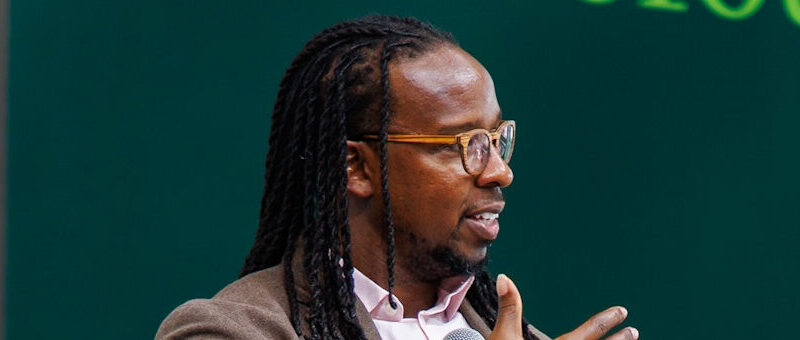
For many people, America’s rapid authoritarian turn came out of nowhere.
Not Ibram X. Kendi.
The author of Stamped From the Beginning and How to Be an Antiracist shows in his new book Chain of Ideas: The Origins of Our Authoritarian Age that America’s anti-democratic policies are part of a worldwide trend—one that long predates the current administration.
But Kendi, now the Carter G. Woodson Endowed Chair of History at Howard University, also takes America to task for failing to live up to its ideals of freedom for all, calling us to hold the United States to account in its next 250 years.
Here’s our complete conversation with Kendi, lightly edited for clarity.
If there’s a main idea you want people to take from your new book and from your work generally in this moment, what would it be?
Ibram X. Kendi: I think I’ve tried in my work to show people the ways in which you have powerful forces — powerful people, often super wealthy — who are trying to accumulate tremendous amounts of power, and who have historically been producing ideas for human consumption. Those ideas are meant to get people to not resist them. They’re meant to get people to resist other people who are like them — who are being subjected in similar ways. These ideas, particularly racist ideas, are designed to get people to think that the very people who are dominating and exploiting them are actually their friends, and that those other people who are also being dominated and exploited are their enemies. Or even to get the primary victims of domination and exploitation — who are being hyper-exploited — to believe that there’s something wrong with them because they’re Black, or Brown, or a woman, or queer. They’re trying to get people to internalize the notion that they are the problem, as opposed to inequality, as opposed to authoritarian power. I’m hoping people will realize just the awesome power of propaganda — particularly ideas — and the effects of those ideas on what we do and see and believe on a daily basis.
How do we convince people that authoritarianism hurts everyone, not just the people they don’t like?
IK: I think this is one of the reasons why, in Chain of Ideas, I wanted people to understand the relationship between power and privilege. We’re living in a moment in which racist power — authoritarian power — is saying to low- and middle-income white people: I am here to protect your privilege. Your ability to not die as quickly, or not be killed by police as much, or not be as impoverished. In order to protect your privilege, I have to assume more power.
And so what happens is people are essentially deciding on the maintenance of their privilege in exchange for democracy. I think those of us who have studied racism have too often conflated power and privilege, because there certainly is a form of power within privilege. But we’re living in a moment in which it’s important to distinguish between the two — and to allow privileged groups to recognize that yes, you have privilege, but you don’t have power. And the more you defend your privileges, and the more you empower those who are defending your privileges, the more you’re actually giving up your power. It’s only going to get worse. You may have a little bit more than someone else, but you’ll still have very little.
I don’t think it’s a coincidence that the world’s first trillionaire is someone who has been one of the greatest promoters on the face of the earth of great replacement theory. This is a person who has promoted this theory in the United States, in Latin America, in Europe, in India — that majority groups or privileged groups are under attack and he’s here to protect and save them. It isn’t a coincidence. Because the more people believe great replacement theory, the more they open themselves up to exploitation at the hands of people like him.
I think the challenge becomes in a country like France — which doesn’t collect racial data, so we can’t say this for certain — but we believe France has the largest Black population in Europe, the largest Jewish population in Europe, and a significant Muslim population. It is a very diverse country. And you have people like Marine Le Pen saying that diversity is anti-white — that every time you see a Black or Brown person, they are coming to replace, displace, and harm white people. That’s ultimately what great replacement theorists believe.
They can’t even imagine that a person of color could have been there for centuries. They can’t imagine that a person of color could arrive and enhance a nation. From their racist perspective, only white people can enhance or develop a nation. And their view of history includes this belief that demographic change somehow stopped at a particular period and is now suddenly starting again. What’s actually different now is that instead of migrants coming from central Europe, they’re coming from Nigeria or Egypt. And those immigrants, ironically, are being described in the exact same ways that previous migrants from central Europe were described — even by the very descendants of those central Europeans in France.
How important is it to take a multi-platform approach to informing people in a moment where it feels like we have all this access to information but struggle to figure out who to trust?
IK: I really respect human beings. And when you respect people, you go to where they are — you don’t sit on top of some hill imagining that people need to come to you. There are people who will read a social media post but not a book. Just as there are people who read a book but aren’t on social media. Just as there are people who engage through something like The Emancipator or a public talk. So I’m constantly trying to think of different ways to meet people where they are.
But I also think that even as people have all this access to information, we are possibly living in a period with the most sophisticated form of propaganda that has ever existed. The level of sophistication, and the tidal wave of propaganda people are being inundated with — on social media, on the nightly news, in newspapers, in text messages, on television, in shows — it’s constant. So it’s important to give people the tools to critically assess what they’re seeing in real time, using the lens of history to do that.
And I think those of us who have specific forms of expertise should be offering that expertise to the general public in ways that make sense to them. With a topic like racism this is harder, because a number of people believe they’re already experts — because they’ve read a few books, or because they’re Black, or because they’ve taken a class. My wife is a physician — a pediatric ER doctor — and she tells me how some days people come to the ER and try to tell her what’s wrong with their child because they read something on the internet. They’re dead wrong. They tell her what remedy to use, and if she actually did it, it would hurt the child. People don’t know what they don’t know. But because of that access to information, they believe they know even when they don’t. That’s why it becomes important for those who have actually studied a topic to constantly educate people so they have a better awareness of what they’re talking about.
We just celebrated America’s 250th anniversary, and you, along with a lot of people including Embrace, have talked about what America actually is versus what we grow up being taught that it is. What does it mean to you to reflect on 250 years of American history, and how do we redefine the United States of America in the next 250 years?
IK: Let me first say that there are Americans who consciously produce narratives that this nation is committed to liberty and equality. And they’re producing those narratives because they benefit from the lack of liberty and equality. They want the masses of people to not resist and to not actually create liberty and equality, because it would undermine their ability to plunder, exploit, and harass as much as they do now. Then you have Americans who have consumed that belief — who genuinely believe that this nation is committed to liberty and equality. Very simply, they’re not resisting. And then you have Americans who’ve rejected that propaganda but who still actually support the ideals of a nation committed to liberty and equality. And so they’ve spent the last 250 years trying to make those ideas real. I think — hopefully — it won’t take another 250 years to make those ideals real. But that is the America I’m fighting for. That is the America my ancestors have fought for.
How important is it for historians, for museums, for the places that hold public memory to hold the line right now when they are under all kinds of assault?
IK: To me, one of the major battles going on right now is between propaganda and truth. Propaganda is one of the major weapons that authoritarian power is using to get people to consent to their own domination. And so all those truth tellers — whether they are journalists, museum professionals, librarians, or scholars — this is the moment in which we have to hold the line. We have to ensure not only that the truth is being told, but that there are actual institutions and organizations committed to truthtelling. Because if you don’t want the truth to be told, you are going to go first and foremost after the institutions, organizations, and professionals who tell it. That’s why all those groups have been bitterly attacked and undermined. But we have to hold the line for truth.